




Nigeria’s fintech sector is not just growing on paper. It is growing on phones.
The Nigeria Smartphone Study 2025 by KPMG and Orange Group Nigeria found that banking and fintech applications reached up to 88% of the smartphones surveyed, making financial services the second most prevalent app category on Nigerian devices after social media and communication platforms.
The findings also reveal a market in transition, one where digital-first payment platforms are outpacing traditional commercial bank apps by a significant margin, and where one platform has pulled so far ahead of its peers that it occupies a category of its own.
This ranking covers digital-first and fintech platforms only. Traditional commercial bank apps, which also appear in the KPMG study, are not included.
Here are the 7 most installed fintech apps on Nigerian smartphones, ranked from 7th to 1st.
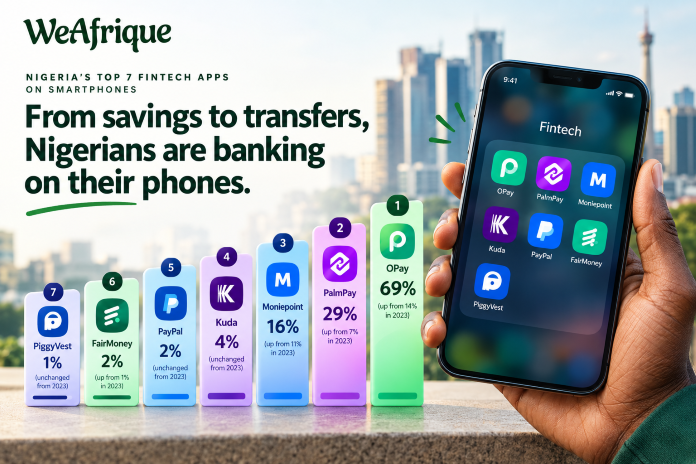
7. PiggyVest — 1% presence (unchanged from 2023)
PiggyVest, Nigeria’s most recognised savings and investment platform, records 1% presence in the study, unchanged from the previous edition.
Founded in 2016 as PiggyBank before rebranding, it pioneered the concept of automated, locked savings among Nigerian millennials and has since expanded into investment products.
Its user base is largely urban, young and financially deliberate, using the platform primarily to build savings discipline rather than manage everyday transactions.
Its flat figure suggests that while PiggyVest retains a loyal niche, it has not meaningfully expanded its installed base since 2023.
6. FairMoney — 2% presence (up from 1% in 2023)
FairMoney, a Lagos-based digital lending and banking platform, records 2% presence in the study, up from 1% in the previous edition.
Licensed as a microfinance bank by the Central Bank of Nigeria, FairMoney built its initial user base around instant mobile loans disbursed entirely through its app, with no physical branch or paperwork required. It has since expanded into current accounts, bill payments and debit cards.
While its overall presence remains modest, the doubling of its installation rate between studies points to gradual but measurable growth in its user base.
- Note: FairMoney and PayPal are tied at 2% presence. FairMoney is ranked below PayPal here as it recorded growth from the previous edition, while PayPal held flat, making PayPal the more established presence at this level.
5. PayPal — 2% presence (unchanged from 2023)
PayPal’s 2% presence on Nigerian smartphones makes it the only international payments platform in this ranking, and its position reflects a specific use case rather than mainstream adoption.
Nigerian freelancers, remote workers and exporters of digital services have long used PayPal as a channel for receiving foreign currency payments, even as the platform’s functionality within Nigeria has historically been limited. Nigerian users can receive funds but have faced restrictions on making outward payments.
Its unchanged figure from the previous study suggests it has not meaningfully grown its Nigerian user base since 2023.
4. Kuda — 4% presence (unchanged from 2023)
Kuda, the Lagos-founded digital bank that markets itself as the bank built for Nigerians, recorded 4% presence in the study.
Licensed as a microfinance bank by the Central Bank of Nigeria, Kuda built its early growth on a zero-fee current account and a mobile-first experience designed to attract younger, digitally active users.
Its 4% figure places it clearly ahead of the two-way tie below it, though its unchanged figure from the previous study suggests its installation growth has plateaued even as competitors like FairMoney recorded increases.
Read Also: 5 Easiest And Cheapest Means Of Sending And Receiving Money In Africa
3. Moniepoint — 16% presence (up from 11% in 2023)
Moniepoint is the most significant entrant in the middle of this list. It was initially built as a business banking and point-of-sale platform serving small and medium enterprises.
The company later expanded into personal banking, growing its smartphone presence from 11% in the previous study to 16% in the latest edition. This was the largest increase recorded by any app in the ranking outside the top two.
The KPMG report explicitly names it as one of the top three banking and fintech apps present on the smartphones of Nigerian users, a reflection of the grip it has developed among traders, retailers and small business owners who rely on its POS terminals and settlement infrastructure for daily operations.
2. PalmPay — 29% presence (up from 7% in 2023)
PalmPay’s 29% presence on Nigerian smartphones makes it the second most installed fintech app in the country by a considerable margin, and its growth from 7% in the previous study is the most dramatic rise of any app in this ranking outside OPay.
Its distribution relationship with Transsion Holdings, the parent company of Tecno, Infinix and Itel, which together account for a dominant share of Nigeria’s device market, has given it access to users at the point of purchase. The app is pre-installed or heavily promoted on the devices Nigerians are already buying.
That structural advantage has carried PalmPay from the lower reaches of the previous study’s rankings to a clear and commanding second position.
1. OPay — 69% presence (up from 14% in 2023)
OPay’s 69% presence on Nigerian smartphones is not just the top figure in this category. It is one of the defining numbers in the entire KPMG study. Its installation rate is more than double that of PalmPay in second place, and it sits ahead of every social media platform except WhatsApp, Facebook and TikTok in the broader smartphone rankings.
The gap between OPay and every other fintech app on this list underlines how completely it has separated itself from the rest of the field. Nigeria’s digital payments market processed ₦1.26 trillion in transactions in 2024, growing at a compound annual rate of 17.67% since 2020, according to Central Bank of Nigeria data cited in the report. OPay has been among the primary platforms driving that volume, expanding from transfers and bill payments into merchant services, agent banking and lending.
Its growth from 14% in 2023 to 69% in 2025, a 55-percentage-point jump in two years, is the single most striking movement in the entire fintech dataset and one of the most remarkable growth trajectories recorded anywhere in this study.
At 69% smartphone presence, OPay is no longer competing in the fintech category. It is the category.