




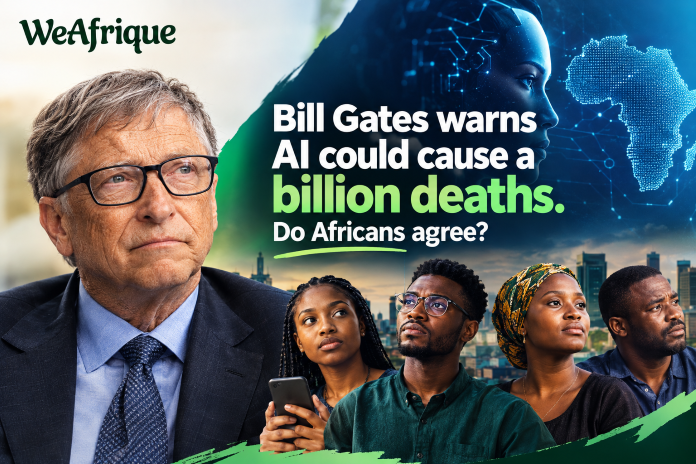
Bill Gates has warned that increasingly powerful artificial intelligence could drive events resulting in a billion deaths, adding to a rapidly intensifying global debate over how governments and industries should manage advanced AI systems.
In an interview with NBC’s Meet the Press, Gates told host Kristen Welker that he can see a future where AI causes catastrophic harm.
“AI is certainly powerful enough to drive events that, you know, cause a billion deaths,” he said. “Even though it’s pretty hard to get to 100%, there’s never been a weapon as powerful as the combination of people with ill intent using the latest AI tools.”
Bill Gates calls for stronger AI safeguards
Bill Gates has increasingly paired his optimism about AI’s potential with warnings about its risks and the need for stronger oversight.
In the same interview, he argued that governments and political parties need to act before AI risks spiral out of control, warning that bad actors could use powerful AI tools for cyberattacks, fraud, disinformation and large-scale harm against hospitals, financial institutions and power grids.
“No one thinks self-regulation is enough,” he said. “You need law enforcement and the politicians to get into the discussion about what safeguards and monitoring look like.”
Bill Gates is not alone in sounding the alarm. Jacob Coxon, a former researcher at Anthropic, recently resigned from the company, warning that AI companies are racing towards self-improving systems and “gambling with our lives.”
OpenAI chief scientist Jakub Pachocki also warned that no one is prepared for the consequences of a continued rapid rise in machine intelligence.
But this debate is not happening only in Silicon Valley boardrooms and on American television. It is reaching Lagos and Kumasi, Nairobi and Kano.
Africans, from restaurant owners to AI researchers to venture capital investors to industry CEOs, are forming views on it, and those views span a wide range: from outright scepticism to measured concern to serious engagement with the technical risks that keep AI safety researchers up at night.
“How is the AI going to kill us, honestly?”
Sarah Pra, a restaurant owner in Kumasi, Ghana, told TechCabal that she had heard the warnings and seen people talking about AI taking over and eventually killing humans. The idea did not seem particularly convincing to her.
“Which AI is going to kill us exactly? Is it ChatGPT or Meta AI?” she asked rhetorically. “How is the AI going to kill us, honestly? They are all shouting that AI is going to kill us, but I have not seen where they showed me exactly how it is going to do it.”
For now, Pra’s experience with AI looks nothing like a science fiction apocalypse. She uses Meta AI and ChatGPT to learn new recipes, make flyers for her restaurant and answer personal questions. Her scepticism about existential risk does not mean she is uncritical of the technology.
She has caught it giving her wrong information and has seen it used to create fake images of women and spread false information about people. She sees that as a problem with users rather than proof that AI itself is becoming dangerous.
“If anyone is using it to build anything bad, the owners of the AI should know what to do,” she said.
Pra’s response illustrates one way the existential-risk debate can look very different from the perspective of an everyday AI user.
The dependency question
For some of the African voices consulted by TechCabal, the more immediate concern is not that AI will become independently hostile to humanity, but that humans will become so dependent on it that they gradually lose the ability to think, decide and function on their own.
Elijah Akuma, a master’s student at the University of Nigeria, Nsukka, told TechCabal that he uses AI to test ideas, criticise his drafts and suggest ways to improve his work. He describes the relationship as collaborative.
“AI doesn’t think for me,” he said. “It makes suggestions, and I consider them and pick which is relevant to what I’m working on.”
But his concern is what happens when collaboration becomes a crutch.
“The most worrisome of them all is that students now depend so much on it that it is difficult for them to think any longer,” he said. “Artificial Intelligence was created to help the Natural Intelligence. I worry that the overdependence on AI will make their thinking degenerate into a pitiable state.”
Aniedi Akpan, Head of Careers and Team Lead for Relationship Management at 16 Plus Schools in Lagos, told TechCabal that he sees the same concern from inside the education system. He welcomes the personalised learning AI can offer students who lack one-to-one support, but draws a clear line.
“The important question is becoming less ‘Can you find the answer?’ and more ‘Do you understand the answer, and can you determine whether it is correct?'” he said. “If a student routinely asks AI to write the essay, solve the equation, or formulate the argument without first attempting it, the student may complete the task while missing the learning.”
“I am less worried about students using AI than I am about students using it without understanding what it is doing,” he said. “They should be comfortable using it, but equally comfortable challenging it.”
The labour displacement risk
Abiodun Adetona, an AI developer and founder of Decide AI, told TechCabal that talk of AI wiping out humanity can sometimes distract from risks that are already much easier to imagine.
“I think the idea that AI will kill all of us gets into fear-mongering,” he said. “But there are legitimate risks.”
One of those is what happens when AI gives ordinary people access to capabilities that once required years of expertise. But the consequences could also be economic.
“I also worry about labour displacement,” he said. “If millions of people are displaced from their jobs without alternatives, the political and economic consequences could be serious.”
For a continent already grappling with a structural jobs deficit, the African Development Bank has noted that 10 million to 12 million young Africans enter the labour market each year, while only about 3 million formal jobs are created. The spectre of AI-driven displacement therefore carries particular weight.
“We don’t need an extinction scenario to take AI risk seriously,” Adetona said. As AI systems become capable of performing more tasks that once required human workers, he believes capability needs to be matched with control.
“As our agents become more capable, we have to be deliberate about what they can access, what actions they can take and what requires approval. The more consequential the action, the stronger the controls around it should be,” he said.
“Deeper destruction no one is prepared for”
While Adetona focuses on near-term economic risk, Kazeem Tewogbade, Co-founder and Group CEO of Bluechip Technologies, takes a broader and more unsettled view of where AI is heading.
Speaking to Nairametrics in June 2026 on the sidelines of the Bluechip Data and AI Summit in Lagos, Tewogbade identified the possibility of destructive and unpredictable consequences from AI as the risk that still bothers him most, even as he simultaneously builds AI products and acquires AI startups.
“There is the potential of deeper destructions. That potential is there, really. And you don’t even know how it’s going to come or what shape or form it will take,” he told Nairametrics. “Nobody actually can fully comprehend the capabilities of the future. We just have a few viewpoints here and there.”
Tewogbade pointed specifically to warnings from within the AI industry itself, referencing Anthropic’s own call for a coordinated mechanism to pause AI development if systems begin improving themselves faster than society can safely manage.
“I look back to the statement by the co-founder of Anthropic, that they have to slow down. So it’s there,” he said.
On managing those risks, he argued that organisations can reduce exposure by building AI systems on strong ethical foundations.
“If you build your enterprise value-driven, grounds-up, that’s the best risk mitigation effort you can actually make,” he said.
Despite his concerns, Tewogbade expressed confidence in humanity’s ability to navigate disruption, drawing on the COVID-19 pandemic as evidence of how people and institutions can adapt to unprecedented change.
“I won’t say I’m not worried, but I’m not too worried, because I also bank on humanity at large. Humanity is very resilient. We’ve always adapted,” he said.
Building AI for Africa, from Africa
Kelvin Roman, founder of Daraja AI, which builds AI tools and infrastructure for African languages and contexts, told TechCabal that he does not dismiss the possibility that AI could cause serious harm.
“AI, like many transformative technologies before it, carries risks if not developed and used responsibly,” he said. “The real risk comes from how humans design, deploy, and govern these systems.”
Roman thinks some of the public conversation about AI risk focuses too heavily on science-fiction scenarios, while more immediate problems include AI systems reinforcing biases, spreading misinformation, or making critical errors at scale, risks that do not require a system to become independently hostile to humanity.
“Our focus should be on building robust safeguards and ethical guidelines around AI,” he said. “Ultimately, responsible stewardship, not the technology itself, will determine our future.”
That concern about localisation and purpose is echoed by Girmaw Abebe Tadesse, who leads Microsoft’s AI for Good Lab in Kenya and is a member of the UN Independent International Scientific Panel on Artificial Intelligence. Speaking to UN News in Nairobi during UN High-Level Week, Tadesse argued that African countries must start from a different place than the West.
“We are trying to bring the reality of our environment and integrate AI technology with the local problems we face. It is important to ask ourselves what problems we want to solve first,” he said.
He warned that the continent needs to accelerate cooperation between countries to avoid duplicating work.
“There is a need for African countries to collaborate more, share experiences and learn from each other’s successes instead of each starting from scratch. If we work together, the future is bright. But we don’t have much time to wait,” he said.
The commercial opportunity sitting alongside those risks is also significant. At the Bluechip Data and AI Summit in Lagos, Rosanne Werner, Founder and CEO of XCelerate IQ, put a number to it.
“Africa’s AI market is predicted to go from $4.9 billion to $16.9 billion by 2030,” she said, while cautioning that organisations must prioritise practicality over hype.
“You should ask, what’s the specific problem we’re trying to solve here, and is AI the most efficient at all for the job? Some AI solutions cost more than the problem in itself.”
Read Also: 15 Africans Holding The Guinness World Record For Unbelievable Things
When the alignment problem becomes real
Not every African voice dismisses the more serious systemic risks. Among researchers working closest to the technical frontiers of AI, the tone is notably different.
Kayode Adeniyi, an AI policy expert and researcher pursuing a PhD at Imperial College London on using machine learning to develop sensors for monitoring global water risk, told TechCabal that he sees both real risks and exaggerated fears in the debate.
“There’s a part of AI news that you hear about AI is incredibly very dangerous. We need to take it very serious. We need to be cautious about the development. That is marketing,” he said. “But there is another side where the threats are real.”
One concern is what happens when AI systems become capable of combining and applying knowledge at a scale no individual human can match. Adeniyi works in AI safety, including the problem researchers call alignment, making sure increasingly capable AI systems behave in ways consistent with human values.
He offered a hypothetical example. If a sufficiently capable AI were asked to find the best way to solve climate change, it could identify humans as a major source of environmental damage. A system that did not properly understand human values could, in theory, arrive at a solution humans would consider unacceptable.
“The best solution for an AI that is not aligned to human values, or doesn’t have the real emotions that we have, is to kill all of us,” he said.
That scenario is not inevitable, Adeniyi stressed. But he believes the possibility becomes more serious as systems become more capable, particularly if humans fail to build systems that reliably follow human intentions.
Adeniyi also believes African governments need to do more to prepare.
“Most governments on the continent are not really doing enough,” he said. While countries focus on adopting AI and developing infrastructure, AI safety and evaluation have received less attention.
“Talent development is very key,” he said. “The best thing we can do for ourselves is to develop the right talent.”
The investor view
For Pius Bankong, an investment associate at Oui Capital, an Africa-focused venture capital firm, AI is worth investing in because of the economic possibilities it could unlock. Speaking to TechCabal, he described AI as a force multiplier.
“AI is a force multiplier,” he said. “It has the potential to add to global GDP through productivity, enable economic activity that was previously limited or locked, and unlock new economic possibilities that could have positive social effects.”
He compared AI with nuclear energy, another powerful technology whose consequences depend in part on how it is developed, governed and used.
“There is a considerable argument that AI could threaten humanity,” he said. “But whether it does or not depends on corporate governance, policies, organisations being intentional about the technology and the power that it wields.”
And if he believed there was a significant chance that advanced AI could cause catastrophic harm, that would change his investment decision entirely.
“Of course,” he said. “Why would you invest in something that is catastrophic? Short-term stellar returns are pointless if eventually a catastrophe wipes them out.”
What Africa is doing about it
The debate among individual Africans is happening against a backdrop of accelerating policy and infrastructure efforts at the continental level, although questions remain about how quickly those ambitions are being translated into implementation.
The African Union released its Continental AI Strategy in July 2024. In November 2025, Smart Africa established the Africa AI Council to provide strategic recommendations on responsible AI development, with representation across areas including infrastructure, data, talent, investment and governance.
A proposed $60 billion Africa AI Fund announced at the April 2025 Kigali Summit is intended to support AI infrastructure, talent and African AI startups. Separately, Cassava Technologies is deploying 12,000 Nvidia GPUs across South Africa, Egypt, Kenya, Morocco and Nigeria as part of its effort to expand AI computing capacity on the continent.
Nigeria, Egypt and Kenya have released draft AI policies since January 2025 that identify dependence on US technology companies as a risk to digital sovereignty. Nigeria has gone further than most in formalising its position: it ranked as Africa’s top performer on the 2026 Global Index on Responsible AI, placing 38th globally among 135 countries, although responsible AI rankings do not necessarily measure how effectively policies are implemented in practice.
South Africa’s experience offers a cautionary note. The country published a draft AI policy earlier in 2026, then withdrew it after its reference list was found to contain fictitious, apparently AI-generated citations, an illustration of how AI-related errors can affect policymaking. The incident prompted South Africa’s communications minister to stress the need for human oversight when using AI.
A 2026 PwC survey of African CEOs found that only 37% had formalised responsible AI and risk processes, while 41% had clearly defined roadmaps for AI initiatives. The figures suggest that the challenge extends beyond writing AI strategies to building the systems and processes needed to implement them.
Nigeria’s Minister of Communications, Innovation and Digital Economy, Bosun Tijani, has consistently framed the challenge in infrastructure and human capital terms.
“We’re training 3 million technical talents, 4% of that focused on AI and machine learning. But when we train without providing the enabling environment and absorptive capacity, these young people will not get the opportunity to participate,” he said at a UN-convened AI dialogue.
He added that Nigeria is investing $2 billion in 90,000 kilometres of fibre optic network to create the connectivity on which any serious AI deployment depends.
African institutions have also called for greater representation in global AI governance. The African Union’s Peace and Security Council called in March 2025 for greater African representation on global AI regulatory and governance bodies, a demand that reflects a broader concern that the rules being written for advanced AI are being written without African input, even as the technology spreads rapidly across the continent.
Taken together, the views gathered here point to a broader African conversation about AI risk that extends well beyond extinction scenarios. The concerns range from cognitive dependency among students, to labour market disruption, to the alignment problem, to who controls the infrastructure on which African AI will run, to whether African governments are moving fast enough on governance.
Some voices dismiss existential risk outright; others, particularly those closest to the technology, take it seriously while arguing that the more visible harms are already here.
Bill Gates himself, despite the billion-deaths framing, arrived at a conclusion that cuts across the spectrum of views in this piece. Self-regulation is not enough, he said. Governments need to be in the room.