




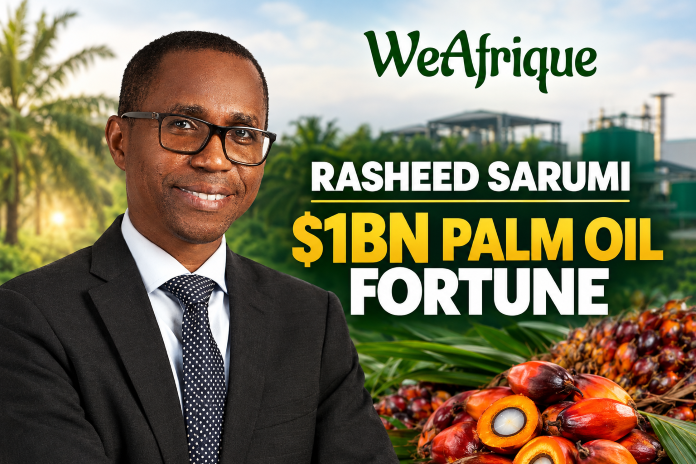
Rasheed Sarumi is close to becoming Nigeria’s first palm oil billionaire. The market value of his effective stake in Presco Plc, the Edo-based palm oil producer he effectively controls through SIAT, passed $1.03 billion in July 2026.
That figure represents the listed value of his look-through Presco position, not a verified net worth, since his debt position from the acquisition that gave him control has not been fully disclosed. But the direction of travel is clear, and the mechanism behind it is worth examining closely.
For most of the modern history of Nigeria’s palm oil industry, Nigerians did not own the companies. Presco, which today dominates Nigeria’s listed agribusiness sector alongside Okomu Oil Palm, spent more than three decades under Belgian family ownership.
Its parent, SIAT SA, became involved in Presco in 1991 and spent more than three decades expanding the company into one of Nigeria’s largest integrated palm oil producers. When SIAT ran into financial difficulty, the company was restructured through a Belgian court process. Sarumi acquired an 86.7 percent stake in SIAT, giving him effective control of Presco.
And what happened next is the story of how a relatively low-profile agro-industrial executive turned that acquisition into a billion-dollar listed position, and is now committing $400 million more to make that position substantially larger.
The man, Rasheed Sarumi
Olakanmi Rasheed Sarumi was born on November 3, 1966, in Ilesa, Osun State. He studied Agricultural Engineering at Obafemi Awolowo University before adding executive education from Harvard and Lagos Business Schools, a combination that gave him both the technical grounding in agriculture and the strategic and financial vocabulary to operate at the level he would eventually reach.
He founded Saroafrica Limited, an agro-industrial and consumer goods group with multiple subsidiaries spanning farming, oil palm, food and lubricants. Through Saroafrica, he built exposure to crop protection, agricultural inputs and farming services before making the move into palm oil production itself.
He served as President of CropLife Nigeria from 2004 to 2008, chaired the Edo State Oil Palm Programme Agro-Allied Limited from 2021 to 2024, chairs the Board of Trustees of the Large-Scale Cassava and Derivatives Processors in Nigeria, chairs the Oil Palm Investors Group in Edo State, and was appointed one of 31 members of President Bola Ahmed Tinubu’s Presidential Economic Coordination Council. His son, also named Rasheed Sarumi, studied at Imperial College London and now works within the group.
He is not a household name. He does not appear on Forbes lists. Until the Presco acquisition forced him into public view, most Nigerian financial media had never profiled him.
The acquisition: buying control from a Belgian court restructuring
In March 2024, Saroafrica International acquired an 86.7 percent stake in SIAT SA through Oak and Saffron, a special purpose vehicle, ending more than three decades of Belgian family ownership of what had become Nigeria’s most significant listed palm oil company.
What Rasheed Sarumi acquired through the restructuring was control of an established, functioning and profitable agro-industrial platform. Presco had roots in the Obaretin Estate established by the Edo State government in the 1970s. SIAT became involved in 1991 and spent more than three decades building it into a fully integrated palm oil business with its own plantations, mills and refinery.
By the time Sarumi acquired control, Presco was already profitable, already dominant in its category and already operating the kind of vertically integrated value chain that is extremely difficult and time-consuming to replicate from scratch.
SIAT holds 520,200,000 Presco shares. By look-through, Sarumi’s effective interest runs to approximately 451 million shares. He was appointed Chairman of Presco Plc in May 2024, shortly after the acquisition completed. He also serves as chief executive of the group.
What Presco is
Presco is among the few fully integrated palm oil producers in West Africa. Integration matters in this sector because most businesses in the supply chain either grow oil palm and sell crude oil, or buy crude oil and refine it.
Presco does all of it, from growing oil palms across its plantation estate to extracting crude palm oil, refining it and fractionating palm kernel oil at its own facilities. Its product range includes refined, bleached and deodorized palm oil, palm olein, palm stearin, palm fatty acid distillate, crude palm oil, and crude and refined palm kernel oil.
Presco and Okomu Oil Palm together dominate the listed sector. Crude and refined palm oil account for 99.9 percent of Presco’s sales, with fresh palm fruit making up the remainder. Every naira of revenue is earned in West Africa. The company employed 1,737 people at last count within its Nigerian operations alone, and more than 20,000 across its extended group including Ghana.
The financial performance reflects that integration. In 2025, total equity rose 109.6 percent to N442.7 billion, equivalent to approximately $277 million. Total assets grew 94.9 percent to N926 billion, approximately $579 million.
Presco and Okomu combined posted N72.86 billion in profit in the first quarter of 2026 alone. The company’s managing director, Reji George, described 2025 as a “defining year,” citing strong earnings growth, successful capital raising and strategic acquisitions as key milestones.
Read Also: How Samuel Dossou-Aworet built a $1.6 billion Nigerian oil portfolio
The expansion programme: $171.6 million already deployed
Before committing the $400 million that is now attracting attention, Rasheed Sarumi had already deployed $171.6 million in acquisitions designed to expand Presco’s plantation footprint and geographic reach.
One of Presco’s first major moves outside Nigeria came through its acquisition of a 52 percent stake in Ghana Oil Palm Development Company, known as GOPDC, for $124.92 million. GOPDC operates two estates spanning 21,000 hectares in Ghana, producing more than 35,000 tonnes of palm oil annually.
Presco subsequently acquired the remaining 48 percent, gaining full ownership. GOPDC’s contribution to Presco’s 2024 revenue was 8 percent, a figure that will grow as the Ghanaian operations are fully integrated.
The second acquisition was Saro Oil Palm Limited, bought by Presco for approximately $46.7 million. Saro Oil Palm, incorporated in 2019, holds a land bank above 14,000 hectares with 5,000 hectares under cultivation in Edo State, and is not expected to turn a profit until 2027.
This transaction carries a governance dimension that cannot be omitted. Sarumi owned Saro Oil Palm through his conglomerate Saroafrica International. He chairs Presco, which bought it. He was therefore on both sides of a transaction of approximately $46.7 million involving a company he controlled.
The arrangement drew criticism from corporate governance observers, and litigation forced Presco’s board to resubmit every resolution passed at its 2024 annual general meeting, including approvals for the Ghanaian acquisition and other strategic moves. The Saro Oil Palm plantation has also faced land grab allegations from surrounding communities, documented by the international watchdog farmlandgrab.org.
Together, the two acquisitions lifted Presco’s plantation area 37 percent, from 43,547 hectares to 59,760 hectares.
The expansion was financed in part by Presco’s shareholders, alongside debt and other funding. Presco launched a rights issue of approximately N250 billion, roughly $163 million, aimed at existing holders, with proceeds earmarked for refinancing debt, settling the outstanding Ghanaian consideration, paying for Saro Oil Palm and building a financial buffer.
In December 2024, Presco also announced a N100 billion Series 1 bond under a N150 billion programme, closing on January 10, 2025, with proceeds directed at the GOPDC acquisition.
The $400 million bet on Nigeria’s palm oil deficit
What Rasheed Sarumi is now doing with Presco goes beyond consolidating what he already controls. It is an argument, expressed in capital commitments, about where Nigeria’s palm oil industry is going.
Nigeria is Africa’s largest palm oil producer. It is also structurally short of palm oil. The country’s crude palm oil deficit runs close to a million tonnes annually, and Nigeria spends approximately $600 million a year importing edible oil to make up the gap. That structural deficit is the commercial foundation on which Sarumi’s expansion thesis rests.
In March 2026, Presco announced a $200 million investment in Abia State, proposing to acquire and develop approximately 14,000 hectares for plantations and agro-industrial processing facilities. Governor Alex Otti, announcing the deal, compared Presco’s ambition to the era of Michael Okpara’s farm settlements, which made the Eastern Region a global palm oil power in the 1960s. Soil sampling and community consultations were already under way at the time of the announcement.
In December 2025, Presco had already bought 10,000 hectares across the Nsadop and Boki plantations in Cross River State, adding further land to a rapidly expanding estate portfolio.
In July 2026, Presco committed a further $200 million to Ondo State, proposing to build plantations, a processing mill and a refinery there. Governor Lucky Aiyedatiwa said publicly that he had made up his mind that Presco must have a presence in the state and would ensure land was made available.
Presco has also begun operations in Ogun State with an initial commitment of approximately $100 million, with total investment projected to rise to between $150 million and $200 million as the project progresses.
The combined new commitment across Ondo and Abia alone totals $400 million, a figure that does not include the Ogun, Cross River or earlier deployments.
Sarumi has said Presco will secure the free, prior and informed consent of host communities, establish clear operational boundaries and implement community action plans wherever it expands.
The structure and the question
Sarumi’s control of Presco runs through a layered structure that has consolidated significantly since the acquisition. Companies House filings show he is the sole director and sole person with significant control of Saroafrica Limited in Britain.
That entity was put into solvent members’ voluntary liquidation in December 2024, after its principal asset had been transferred into the Presco structure. The group now operates in Nigeria, Ghana, the United States, China and Belgium, where SIAT is headquartered.
The unanswered question is the one Billionaires.Africa flagged when the listed value of Sarumi’s stake passed $1 billion in July 2026: whether he is a billionaire in net terms depends on what he owes. The acquisition of an 86.7 percent stake in SIAT through a Belgian court restructuring was complex, and the financing arrangements behind it have not been fully disclosed.
The listed value of his look-through Presco position is not in dispute. What the liabilities behind the acquisition vehicle amount to remains unknown.
For Rasheed Sarumi, the next phase of the Presco story is therefore about more than a billion-dollar listed position. It is about whether the platform he acquired control of in 2024 can be expanded into a much larger African palm oil business, and whether Nigeria’s persistent supply deficit is large enough to support the scale of investment now being planned.