



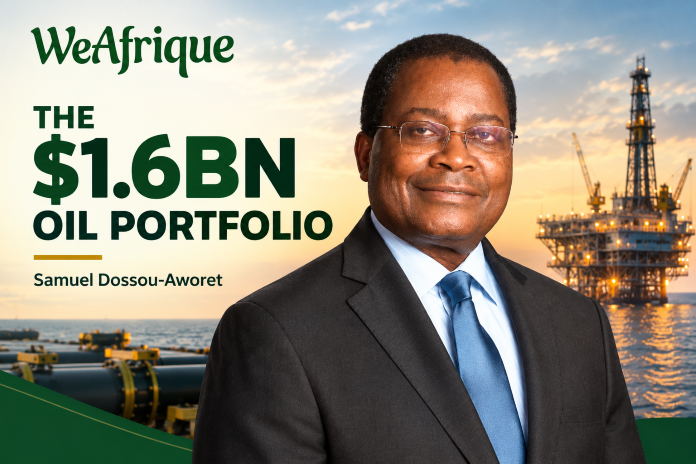
The man does not give interviews. His name does not appear in the same breath as Dangote or Elumelu when African business fortunes are discussed.
And yet, as of September 30, 2026, Samuel Dossou-Aworet, an 81-year-old engineer born in Porto-Novo, Benin, holds $1.59 billion worth of shares in two Nigerian oil producers, making him one of the largest disclosed shareholders by value on the Nigerian Exchange.
The portfolio is split between two positions: 81,015,319 shares in Seplat Energy, representing approximately 13.5 percent of the company, and 532,693,719 shares in Aradel Holdings, representing approximately 12.3 percent.
Both were accumulated quietly, through Petrolin vehicles that attract minimal public attention, over a period spanning more than twenty years. These figures represent the value of his two disclosed Nigerian listed holdings, not the entirety of his wealth, which spans additional positions across Tullow Oil, ND Western, OML 34 and other African energy assets.
Neither position attracted significant public attention for much of that period, despite the scale of the holdings.
To understand how a Beninese engineer ended up as one of the most consequential shareholders in Nigeria’s upstream oil sector, you have to start not in Lagos or Geneva, but in Libreville.
Thirteen years inside Gabon’s oil machinery
Samuel Dossou-Aworet was born on November 5, 1944, in Porto-Novo, the capital of what is now Benin. He trained as an engineer in France, graduating in petrochemistry and industrial organic synthesis in 1971 and taking a second qualification at the French Institute of Petroleum in 1972. He spent 1973 and 1974 as a consultant at Sema Metra International in Paris before Gabon brought him in as an adviser to its minister of mines, energy and petroleum in 1974.
It was the beginning of a relationship with Gabon that would define the first half of his career and eventually grant him honorary citizenship of a country that was not his own.
He became Director General of Hydrocarbons in 1978, a post he held until 1991, then served as General Commissioner for the Inspection and Control of Hydrocarbons and Mines until 1992.
During that period he served as a governor of the OPEC Special Fund from 1976 to 1980, chaired the OPEC Board of Governors across two terms, represented Gabon at the African Petroleum Producers Association from 1988 to 1992, and chaired that body’s expert committee. He was also a close adviser to the late President Omar Bongo Ondimba. His wife, Honorine Dossou-Naki, served as Gabon’s ambassador to Paris and London.
His years inside Gabon’s oil sector gave him extensive experience in the administration and development of African oil assets. When he left government in 1992, he moved into the private sector.
Petrolin, Energy Africa and the $500 million transaction
Samuel Dossou-Aworet founded Petrolin UK in London in 1992 as a crude oil trading and refinery processing business. The following year, he moved the headquarters to Geneva, where it has remained. Advisory mandates followed for Benin, Congo, Gabon, the Democratic Republic of Congo and Chad, for OPEC and the African Petroleum Producers Association, and for international oil companies including Tullow Oil.
A deal that significantly expanded his wealth came two years after Petrolin’s founding. In 1994, Dossou-Aworet co-founded Energy Africa, a pan-African exploration business built with the South African refiner Engen Petroleum, and spent a decade assembling assets down the west coast of the continent.
Petronas, the Malaysian state oil company and parent of Engen, moved to acquire Energy Africa in 2003. Dossou-Aworet blocked it. He wanted the company to retain its African identity, and the bid failed. Tullow Oil bought it the following year for $500 million. The transaction doubled the size of the Irish-founded explorer overnight, handed it assets stretching from Ghana to Namibia, and delivered the acreage on which Tullow later found the Jubilee and TEN fields, its two most significant discoveries. Dossou-Aworet took shares in Tullow as part of the consideration.
He did not become a passive holder. When Tullow’s stock collapsed in late 2019 after the company cut production forecasts, suspended its dividend and lost both its chief executive and its exploration director simultaneously, Dossou-Aworet disclosed he had crossed the 3 percent shareholding threshold and kept buying through the slump.
By the time the filings settled, he held just over 7 percent and had become the company’s largest individual shareholder. British financial media speculated he might mount a bid. None came. He reached approximately 13 percent by mid-2020 and raised his stake from 12.7 percent to 16.6 percent in June 2023, built through five separate companies including Petrolin Trading. The Tullow position illustrates a documented pattern of accumulating stakes in African energy companies during periods of uncertainty or falling valuations.
Read Also: From Diesel to Banking: How Femi Otedola Built His $2 Billion Fortune
Nigeria: the first move, twenty years in the making
Dossou-Aworet’s Nigerian position began in 2005, when Petrolin took a participating interest in Niger Delta Exploration and Production, the company that later became Aradel Holdings and listed on the Nigerian Exchange in 2022. The Seplat holding was built during that company’s early years, accumulated through Petrolin Trading Ltd, which now holds 81,015,319 ordinary shares representing approximately 13.5 percent of the company.
For most of the period between 2005 and 2022, both positions were essentially invisible to casual observers. Neither company was widely covered outside the specialist energy press, and Petrolin’s structure across multiple vehicles made the combined position difficult to track without deliberate effort.
That began to change when Aradel listed in 2022, when Seplat’s share price began to reflect the scale of its ExxonMobil asset acquisition, and most dramatically in 2025, when Dossou-Aworet’s Petrolin Group joined the transaction that reshaped Nigeria’s upstream oil landscape.
The Shell deal
In January 2024, Shell announced an agreement to sell its 30 percent interest in the Shell Petroleum Development Company of Nigeria joint venture to Renaissance, a consortium comprising Waltersmith Group, ND Western, First E&P, Aradel Holdings and Petrolin Group. The transaction was valued at $2.4 billion.
Renaissance completed the acquisition in March 2025, clearing the regulatory approvals required by the Nigerian Upstream Petroleum Regulatory Commission and the Federal Competition and Consumer Protection Commission. The transaction transferred Shell’s onshore SPDC business to the Renaissance consortium.
Africa Confidential assessed the deal while it was still pending, writing that if completed it would leave Dossou-Aworet the single most important oil executive in Nigeria measured by upstream exploration and production assets. The deal completed.
Aradel holds 33.34 percent of the Renaissance consortium, comprising 12.5 percent directly and 20.84 percent through ND Western. Dossou-Aworet chairs ND Western and separately holds his Aradel stake through Petrolin Ocean Limited. In October 2025, Petrolin Trading agreed to sell its 40 percent stake in ND Western to Aradel, subject to regulatory approvals. That transaction, if completed, would consolidate Aradel’s position in the Renaissance structure while converting Dossou-Aworet’s ND Western interest into cash or Aradel paper, further deepening a position he has been building for more than twenty years.
The Aradel top-up: $64 million in a single transaction
His Aradel position stood at 8.31 percent at the end of June 2025. On September 25 of that year, Petrolin Ocean Limited bought 173.79 million additional shares at an average price of 555 naira per share, spending 96.45 billion naira, equivalent to approximately $64.4 million at the time. That lifted the holding to 13.77 percent and made Dossou-Aworet Aradel’s largest individual shareholder.
Aradel traded at approximately 560 naira the week of the purchase. By September 30, 2026, it closed at 1,530 naira. In a single year, the share price had risen to nearly three times the 555 naira average price paid in that transaction.
That top-up is perhaps the most revealing single data point in this story. It was not simply an inherited or longstanding position. Samuel Dossou-Aworet deliberately increased his exposure to a Nigerian oil producer at a specific price, in a specific market, at a time when the company was still trading at a fraction of its later 2026 valuation. The subsequent appreciation shows how significantly the value of that investment has increased, but the decision to increase the stake came first.
What a quarter did to the portfolio
The combined market value of Dossou-Aworet’s two Nigerian stakes increased by about $430 million in the third quarter of 2026.
Seplat generated most of the gain. The company’s shares rose 40.8 percent during the quarter, from 11,363.90 naira on July 1 to 16,000.10 naira on September 30. The stock moved in large single-day jumps: it rose 10 percent on September 3, another 10 percent on September 10, then gained 7.3 percent on September 24 to reach a record 16,000 naira.
Crude oil prices rose above $100 a barrel in September after disruption to tanker traffic through the Strait of Hormuz cut global supply. Seplat also reported a 74.1 percent rise in first-half profit before tax to 790.4 billion naira, reflecting the scale of the ExxonMobil asset acquisition completed before the quarter began.
The value of Dossou-Aworet’s 81,015,319 Seplat shares rose from $667.1 million on July 1 to $976.1 million by September 30, an increase of $309 million in the quarter.
Aradel added the rest. Its shares rose 19.9 percent over the quarter, from 1,275.80 naira to 1,530 naira. The value of his 532,693,719 Aradel shares increased from $492.4 million to $613.7 million, a gain of $121.3 million. The naira’s strengthening over the period, from 1,380.17 per dollar on July 1 to 1,328.02 on September 30, added approximately 4 percent to the dollar value of both positions.
On September 30, 2026, Billionaires.Africa calculated his combined Nigerian stake at $1.59 billion.
What else he holds
The Nigerian portfolio is not the full picture. Petrolin Group operates across more than ten African countries, and Dossou-Aworet has provided advice or taken positions across Cameroon, Chad, Congo, Cote d’Ivoire, the Democratic Republic of Congo, Egypt, Equatorial Guinea, Gabon, Mauritania, Mauritius, Morocco, Namibia, Senegal, South Africa, Uganda and Yemen. Petrolin holds a 45 percent interest in Nigeria’s OML 34 and markets Gabonese crude. His Tullow Oil stake, which he built to 16.6 percent, represents a further position in West African upstream exploration through its Ghana and Kenya assets.
His institutional footprint is equally extensive. He co-founded the African Institute of Petroleum in 1996 and chairs it. He serves as president of the African Business Roundtable, which the African Development Bank established in 1990. He sits as vice chairman of the Pan-African Private Sector Trade and Investment Committee. He founded the Fondation Espace Afrique. He sits on the board of the Corporate Council on Africa. France made him an Officer of the Legion of Honour. Gabon made him a Grand Officer of the Order of the Equatorial Star.
His infrastructure project in Benin, the Backbone Project, is an integrated rail, port and airport corridor that he has described as a means of opening economic opportunities for African entrepreneurs and workers using resources already within the continent’s reach.
The man almost no one tracks
What makes Samuel Dossou-Aworet unusual is not the size of the portfolio. It is the method.
He built Petrolin from a London crude trading business, co-founded Energy Africa, watched Petronas try to acquire it and blocked the bid, sold it to Tullow for $500 million and took shares in the buyer, then accumulated a 16.6 percent stake in Tullow itself during a period of crisis.
He entered Nigerian upstream oil through Niger Delta Exploration and Production in 2005, held through the long years when neither the company nor its successor was generating headlines, bought more Aradel at 555 naira when the market was not watching, and joined the Renaissance consortium that completed the acquisition of Shell’s Nigerian onshore assets.
Samuel Dossou-Aworet has done all of this through low-profile Petrolin vehicles, across multiple jurisdictions, without attracting the attention that typically accompanies holdings of this scale. He has given almost no public interviews about any of it.
By the end of the third quarter of 2026, that accumulation was worth $1.59 billion on the Nigerian Exchange alone.