



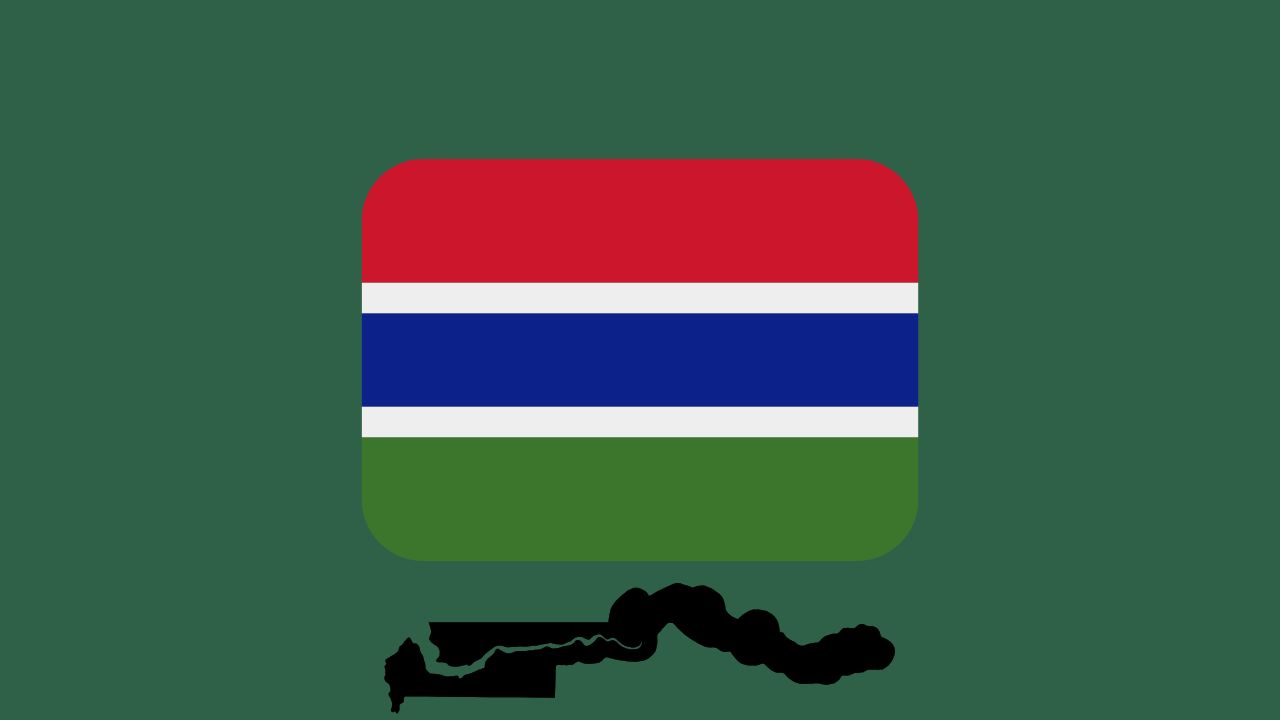
The Gambia is the smallest country in mainland Africa and the most densely populated. Named after one of West Africa’s major rivers, the River Gambia, the country is also known for its rich culture, history, natural beauty, and warm-hearted people, which earned the country the nickname- the smiling coast of Africa.
- Capital: Banjul
- Languages: English (Official language), Mandinka, Fulde, and Wolof
- President: Adama Barrow
- Continent: Africa
- Population: 2.698 million
- Area: 11,200 km2
- Religion: Islam (56%), Christianity, and African traditional religion (4%)
10 Interesting Facts about The Gambia
1. The Gambia is the smallest country in mainland Africa
This African country has been described as an incredibly narrow country measuring less than 30 miles wide. It is surrounded by Senegal at all borders except for its western region, which is on the Atlantic Ocean. Also, the Republic of Gambia occupies a long, narrow strip of land that surrounds the Gambia River.
Due to the peculiar shape and size of the country, territorial compromises were made during the 19th century by Great Britain and France.
In addition to that, the country is also one of Africa’s most densely populated countries. As of 2022, the Gambia’s population is estimated to be around 2.41 million.
2. More than half of the country’s population depends on Agriculture for their livelihood
Agriculture is a major source of income for most Gambians. Although the country also relies on tourism, about 80% of the population is employed in the agricultural sector.
The government has invested in that sector, such that agriculture provides about one-third of the GDP. One of the biggest cash crops in the country is groundnuts (peanuts).
3. The Gambia is predominantly a Muslim country
Although the country is said to be very tolerant of different religions, more than 96% of its population identify as Sunni Muslims. The other percentage constitutes Christianity and other traditional religions, such as the Serer religion and the Jola people.
4. There are varieties of ethnic groups in The Gambia
The Gambia is a former British colony; hence, English is widely spoken. In spite of that, there are quite a number of tribes in the country.
The largest and most spoken languages are Mandinka, Fula, Jola, Sarahule, Serere, and Wolof. Other ethnic groups that are regarded as the smallest groups in the country include the Krio people, also known as Akus, Bambara, and Mangajo.
Each of these ethnic groups preserves its language and traditions in different ways.
5. The Gambia served as a host country for refugees from neighboring West African countries
Due to the country’s location, the Gambia has been a destination country for both migrants and refugees. In the 1980s, economic deterioration and a high rate of unemployment in the country forced its citizens to migrate to countries such as Spain, the United States, Nigeria, Senegal, and the UK.
While most of the citizens have migrated to other countries in search of greener pastures, the country has acted as a host country to so many refugees during wars or unrest from the neighboring Western African countries. This has taken a toll on the country because it reportedly increased the poverty rate among Gambian villagers.
6. There are sparse natural resource deposits in the West African country
The country has sparse natural resource deposits; therefore, it relies on remittances from workers overseas and also on tourist receipts. The revenue makes up about one-fifth of the country’s GDP.
Thanks to its location, Gambia’s proximity to Europe has made it one of the most frequented tourist destinations in West Africa. Before now, the tourism sector in the country generated about 20% of the GDP, but it changed in 2014 when tourists fled due to diseases like the Ebola virus.
See Also: 10 Interesting Facts about Mauritania
7. The country is home to more than 600 species of birds
Described as a bird’s paradise, The Gambia is home to more than 600 species of birds found in its forests and river banks. It also has an extravagant wildlife, decorated by the presence of crocodiles, hippos, monkeys, and more.
8. Gambians used to cast their votes with marble
Gambia has a unique way of voting during elections. Voters are presented with holes in the ground marked with the candidates’ names, and they are expected to drop a marble into the hole of their preferred candidate.
This system of voting was introduced in the early 1960s to address the high level of illiteracy in the country.
9. The Country was once a center of the slave trade
UNESCO once listed Kunta Kinteh Island, formerly called James Island, as a place that played a pivotal role in the slave trade when captives were transported downriver from the 1500s to the early 1800s.
This is highlighted in the best-selling book, Roots, by American author Alex Haley. In the same place, there’s a museum of slavery that still displays artifacts such as chain neck collars, foot cuffs, and yokes.
10. The Gambia was once part of the empire of Ghana from the 5th to the 11th Century
From the 5th to the 11th century, the Gambia was part of the Ghana Empire. Then, from the 13th century, it was under the Empire of Mali.
Things changed in the 16th century when the Portuguese slave traders and gold seekers came to settle in the lower river area. It was at that time that the carving of what would today be known as the country, the Gambia, began.