



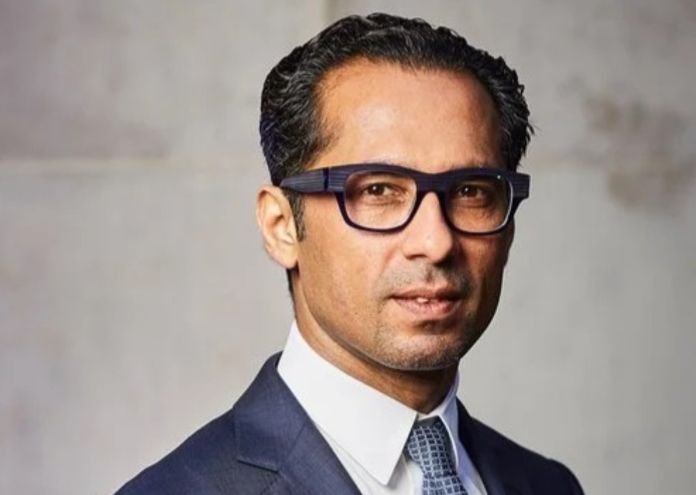
Forbes’ real-time tracker valued Mohammed “Mo” Dewji at $2.1 billion on September 15, and he ranks No. 1,982 on its 2026 billionaires list.
Forbes Africa ranks him 14th among African billionaires and does not classify him as self-made, since MeTL was founded before him.
That distinction matters because Dewji joined an existing family business and expanded it through acquisitions, manufacturing and distribution.
A shop in Singida
The business began small. Dewji’s grandmother sold sugar, rice and matchboxes from her mud-and-sand home in Singida, a town in central Tanzania. His father, Gulamabbas, turned that into an import-export business by the mid-1970s.
MeTL, short for Mohammed Enterprises Tanzania Limited, was founded in Dar es Salaam in the 1970s as an importer of consumer goods. Dewji recalls his father taking him to work during school holidays from the age of 11.
He studied international business and finance, with a minor in theology, at Georgetown University, then took a Wall Street job. By his account he worked 100-hour weeks for a little over $60,000 a year.
When he asked his father for money to cover Manhattan rent and taxes, he was told to come home to the family business. He joined MeTL in 1998 or 1999, depending on the source.
The privatisation bet
The business he joined was a trading house, and he found trading a thin-margin business. He wanted to manufacture what MeTL imported, edible oils and soap among them, but his father asked him to wait.
The opening came when the government began selling off loss-making state companies. New African dates this to early 2000, while Dewji himself has dated it to 2003.
He recalls borrowing money and buying “sick” operations in soap, grain milling, rice, sugar blending, edible oil and textiles.
He describes his method as a quasi-leveraged buyout. He buys a distressed, badly managed company, restructures it and puts its products through MeTL’s distribution network, financing it more cheaply than a small owner could.
Several of the resulting businesses still anchor the group:
- Edible oils. In an interview around 2017, Dewji said the refinery he bought in 2005 became East Coast Oils and Fats, with a 60% domestic market share and over 30% of group revenue.
- Textiles. He rehabilitated run-down state mills with European and American machinery, and the group produces more than 100 million running metres of fabric a year.
- Beverages. He built A-One Products & Bottlers from government-owned bottling plants, spending $48 million over time. According to that interview, it made cola, orange drinks and an energy drink.
The everyday-life thesis
Dewji told Forbes Africa in 2021 that when he left university in 1998-99, per capita income in Tanzania was about $300, and that it was over $1,000 by 2021.
He wanted a large share of what people spend from morning to night, on tea, sugar, flour, drinks, bicycles and garments, and he described competing with Unilever, Procter & Gamble and Coca-Cola.
That strategy shows up in the brands. A profile from around 2017 listed Fluordent toothpaste, Mo soap, Poa and Taifa detergents, Safi flour and cooking oil, Maisha water and KK sugar.
It also credited MeTL with more than 100 trade outlets and a fleet of over 1,000 vehicles. One critic in that piece, family friend and businessman Rostam Azizi, said much of the business was still trading, with MeTL importing goods and putting its own name on them.
The numbers
MeTL is private, so its figures are estimates or company statements. Revenue was roughly $30 million around 1999, though one profile puts it at $26 million. It had reached about $1.5 billion by around 2018, and New African put it near $2.5 billion in 2023, with about 38,000 employees.
African Business reported in August 2026 that revenue exceeded $3 billion, without saying how the figure was calculated. That would be roughly 3% of Tanzania’s GDP, with about 40,000 employees across 11 countries.
MeTL does not appear to publish audited accounts, and the figure is well above earlier estimates.
Forbes named Dewji a dollar billionaire in 2015. It valued him near $1.5 billion at the time of his 2018 kidnapping, $1.6 billion in October 2021, and $1.5 billion at the start of 2024.
He reached $1.8 billion at the start of 2025 and $2.2 billion by March 2025. Forbes Africa’s 2026 profile shows $2.1 billion, down 4.5%.
Read Also: What Dangote Refinery November Debut Could Do to His $51 Billion Fortune
Politics, a kidnapping and giving
Dewji was also a politician. He was MP for Singida Urban from 2005 to 2015, and in 2016 became the first Tanzanian to sign the Giving Pledge, committing at least half his wealth to philanthropy.
On October 11, 2018, gunmen seized him as he arrived at the Colosseum Hotel gym in Dar es Salaam. His family offered a TSh1 billion reward, and he was freed in the early hours of October 20. Forbes and Bloomberg counted nine days; the BBC counted ten.
The BBC also reported that it was unclear how he was released or whether a ransom was paid. Dewji has said the ordeal pushed him toward philanthropy. In 2021 he said he worked 80 hours a week, down from 100. His foundation reports 13,900 cataract surgeries.
Expansion, and government scrutiny
Dewji is now 51 and still expanding. In 2021 he told Forbes Africa he wanted to step down by 50 and focus on philanthropy. Instead, in August 2026, he pledged $250 million to Mozambique after meeting President Daniel Chapo, promising to try to employ 20,000 Mozambicans.
He then met Botswana’s president, its central bank governor and its stock exchange leadership, and in May announced a $50 million soft drinks plant in Kenya. His target is a $10 billion MeTL by 2030, driven partly by graphite mining and luxury tourism.
The agricultural push has drawn scrutiny. In 2024 he told Forbes he wanted to invest $250 million, $100 million of it his own, to buy and mechanise 100,000 hectares of Tanzanian farmland.
Forbes noted that the plan involved land transfers in 17 villages and raised concerns about displacing farmers. The government had already acted against idle MeTL land: in 2019 it revoked titles to six farms totalling about 12,915 hectares in Tanga.
In September 2025, President Samia Suluhu Hassan said at a rally that the government planned to take back a tea estate in the Southern Highlands that had not been developed as agreed at privatisation.
MeTL then secured $24.6 million from the African Development Bank, part of a $74.7 million programme to modernise its tea, sisal and macadamia operations. By May 2026, a deputy minister told parliament the government was negotiating to buy the estates and reallocate them to smallholders, with factories going to cooperatives.
The $2.1 billion is Forbes’ estimate of Dewji’s net worth; MeTL is a private, unlisted company. What is clearer is the trajectory: a business with roughly $30 million in revenue around 1999 that now reportedly generates more than $3 billion a year.
***
Note: MeTL’s revenue and headcount figures are estimates or company statements. MeTL is private and does not appear to publish audited accounts. Net worth figures are Forbes estimates as of the dates given.